Selectivity in Olefin-Intervened Macrocyclic Ring-Closing Metathesis
Ruzhang Liu*, Hua Ge, Kuanwei Chen, and Huaiguo Xue
College of Chemistry and Chemical Engineering, Yangzhou University, 180 Siwangting Road, Yangzhou 225002, People’s Republic of China
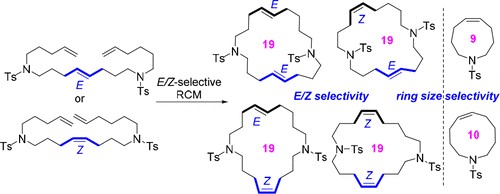
The ring-closing metathesis (RCM) of α,m,ω-triene was employed for the syntheses of four slightly differentEE,EZ,ZE, andZZisomers of macrocycles with two greatly separated type I olefins. Kinetic control of the RCM reaction usingG1was achieved, in which secondary metathesis of the initially formed RCM product that usually afforded the thermodynamically favored product was inhibited, and a reliable model was built to differentiate the kinetic or thermodynamic control in the RCM reaction. Kinetic studies of olefin metathesis using the kinetically controlledZ-selective catalystCat-Zwere conducted to determine its thermodynamic capability to convert (Z)-olefin to (E)-olefin. Finally, the ring size selectivity of α,ω- vs α,m-/m,ω-products in the RCM reaction of α,m,ω-triene revealed that all types of isomeric α,ω-products are favored for the 18-membered ring and above, and α,m-/m,ω-products are predominant for the rings with 14-members and less. For the 15-, 16-, and 17-membered rings, each of theE/Z-selective RCM reactions of starting (mE)- and (mZ)-trienes has a different performance under the optimized conditions. These studies provide insights into the applications of RCM on the synthesis of macrocycles with two separate type I olefins.
ACS Catal., 2018, 8, pp 5574–5580.DOI:10.1021/acscatal.8b01084
链接:https://pubs.acs.org/doi/10.1021/acscatal.8b01084.

 苏公网安备 32100302010246号