Multinary metal chalcogenides with tetrahedral structures for second-order nonlinear optical, photocatalytic, and photovoltaic applications
Man-Man Chen, Huai-Guo Xue, Sheng-Ping Guo*
School of Chemistry and Chemical Engineering, Yangzhou University
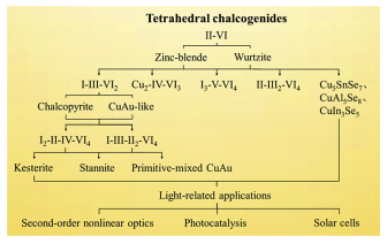
Abstract:There are a large number of metal chalcogenides crystallized in the wurtzite or zinc blende-derived structures, in which all of the anions or cations are fourfold-surrounded by their neighboring counter ions. These compounds can be defined as tetrahedral chalcogenides. According to valence electrons’ configuration obeying valence electron rules or not, they can be classified into two types, normal or defect tetrahedral chalcogenides. There is a closely structural relationship between them. As all the atoms have the tetrahedral-coordination styles, structure disorders of occupancies or sites can be easily happened to them. So, there are also many alloys or solid-solutions members belonging to tetrahedral chalcogenides. In view of their special structure features, rich chemical compositions, and tunable optical band gaps, they are ones of the most promising second-order nonlinear optical (NLO), photocatalytic, photovoltaic (PV), and thermoelectric candidate materials. In fact, most of these chalcogenides can be applied in more than one of the aforementioned fields.
Coordination Chemistry Reviews, 2018, 368, 115-133.IF = 13.324
链接:https://www.sciencedirect.com/science/article/pii/S0010854518300584

 苏公网安备 32100302010246号