Coaxial Carbon/MnO2 Hollow Nanofibers as Sulfur Hosts for High-Performance Lithium-Sulfur Batteries
Lubin Ni,†,*[a] Gangjin Zhao,†[a] Yanting Wang,[a] Zhen Wu,[a] Wei Wang,[a] Yunyun Liao,[a] Guang Yang,[a] Guowang Diao*[a]
aCollege of Chemistry and Chemical Engineering, Yangzhou University, Yangzhou 225002, Jiangsu, People’s Republic of China
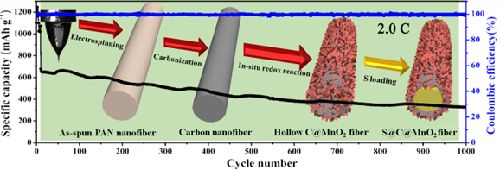
Abstract:Lithium-sulfur (Li-S) batteries have recently attracted a large amount of attention as promising candidates for next-generation high-power energy storage devices because of their high theoretical capacity and energy density. However, the shuttle effect of polysulfides and poor conductivity of sulfur are still vital issues that constrain their specific capacity and cyclic stability. Here, we design coaxial MnO2-graphitic carbon hollownanofibersas sulfur hosts for high-performance lithium-sulfur batteries. The hollow C/MnO2 coaxial nanofibers are synthesized via electrospinning and carbonization of the carbon nanofibers (CNFs), followed by an in situ redox reaction to grow MnO2 nanosheets on the surface of CNFs.The innergraphiticcarbonlayer not only maintains intimate contact with sulfur and outer MnO2 shell tosignificantlyincrease the overall electrical conductivitybut alsoacts as a protective layer to prevent dissolution of polysulfides. The outer MnO2 nanosheets restrain the shuttle effect greatly through chemisorption and redox reaction. Therefore,the robustS@C/MnO2nanofiber cathode deliversextraordinaryrate capability, andexcellent cycling stability with capacity decay rate of 0.044 and 0.051 % per cycle after 1000 cycles at 1.0 C and 2.0 C, respectively.Our present work brings forward a new facile and efficient strategy forthe functionalization of inorganicmetal oxide on graphitic carbons as sulfur hosts for high performance Li–S batteries.
Chem -Asian J, 2017,DOI: 10.1002/asia.201701343
文章链接: http://onlinelibrary.wiley.com/doi/10.1002/asia.201701343/full

 苏公网安备 32100302010246号