Self-assembled three-dimensional graphene/polyaniline/polyoxometalate hybrid as cathode for improved rechargeable lithium ion batteries
Lubin Nia,*, Guang Yanga, 1, Chunyu Suna, 1, Guosheng Niua, Zhen Wua, Chong Chenb, Xiangxiang Gongb, Chuangqiang Zhoub, Gangjin Zhaoa, Jie Gua, Wei Jia, Xin Huoa, Ming Chena, Guowang Diaoa,*
aSchool of Chemistry and Chemical Engineering, Yangzhou University, Yangzhou, 225002, Jiangsu, People's Republic of China
bTesting Center, Yangzhou University, Yangzhou, 225002, Jiangsu, People's Republic of China
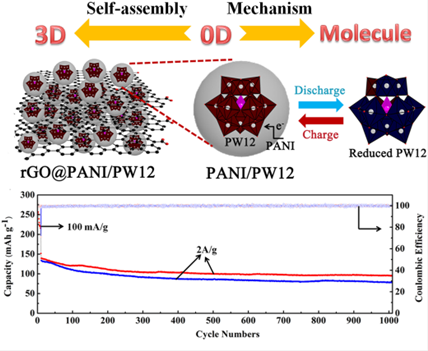
Abstract:The energy crisis is currently a major concern worldwide due to the limited natural resources. Accordingly, lithium-ion batteries (LIBs) are in the focus of forefront energy storage investigations in our 21stcentury. Traditional lithium-insertion compounds for cathode materials, such as LiCoO2, LiMn2O4, LiNiO2and LiFePO4, have been highly successful but they face serious limitations in energy storage density and production cost associated with their use. Therefore, the design of novel molecular cluster batteries (MCBs) as the next-generation energy storage device is an extremely important and hot topic of current research. Here, we first report preparation of zero-dimensional (OD) polyaniline/polyoxometalates [PW12O40]3-(PANI/PW12) nanospheres, and then have successfully embedded PANI/PW12nanospheres into three-dimensional (3D) graphene sponge to construct a novel 3D graphene/polyaniline/polyoxometalates hybrid (rGO@PANI/PW12) as new cathode material in LIBs. The as-prepared rGO@PANI/PW12hybrid in half-cell exhibits extraordinary electrochemical performances with high specific capacity (around 285 mAh g1 at 50 mA g1), excellent rate capability (140 mAh g1 at 2 A g1), and outstanding cycling stability (capacity fade rate of 0.028% per cycle even after 1000 cycles at 2 A g1), representing the best performance for long-cycle POMs-based cathode in LIBs to date. Furthermore, a rGO@PANI/PW12-C lithium ion full-cell is first fabricated with an initial discharge specific capacity of 145 mAh g1 at 2 A g1, and then shows excellent cycling stability with a capacity decay rate of 0.035% per cycle over 1000 cycles at 2 A g1. Importantly, the discharge and degradation mechanisms of rGO@PANI/PW12cathode in LIBs are further deeply investigated. The electron-transfer (ET) from reduced PANI polymer to PW12polyanion as well as the “electron reservoir” model on PW12molecule both contribute to the high electroactivity. This study sheds thus new lights to the design of new generation electrode materials for lithium-ion batteries.
Materials Today Energy6 (2017) 53-64
文章链接: http://www.sciencedirect.com/science/article/pii/S2468606917301211

 苏公网安备 32100302010246号