倪鲁彬副教授与刁国旺教授共同在ACS Appl. Mater. Interfaces发表研究论文
Dual Core−Shell-Structured S@C@MnO2 Nanocomposite for Highly
Stable Lithium−Sulfur Batteries
Lubin Ni,* Gangjin Zhao, Guang Yang, Guosheng Niu, Ming Chen, and Guowang Diao*
School of Chemistry and Chemical Engineering, Yangzhou University, Yangzhou 225002, Jiangsu, People’s Republic of China.
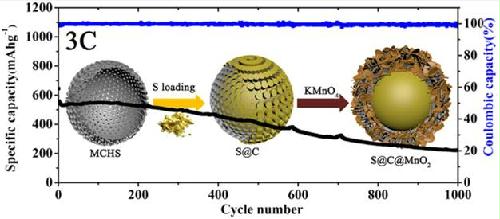
Abstract:Lithium−sulfur (Li−S) batteries have currently excited worldwide academic and industrial interest as a nextgeneration high-power energy storage system (EES) because of their high energy density and low cost of sulfur. However, the commercialization application is being hindered by capacity decay, mainly attributed to the polysulfide shuttle and poor conductivity of sulfur. Here, we have designed a novel dual core−shell nanostructure of S@C@MnO2nanosphere hybrid as the sulfur host. The S@C@MnO2nanosphere is successfully prepared using mesoporous carbon hollow spheres (MCHS) as the template and then in situ MnO2growth on the surface of MCHS. In comparison with polar bare sulfur hosts materials, the asprepared robust S@C@MnO2composite cathode delivers significantly improved electrochemical performances in terms of high specific capacity (1345 mAh g−1 at 0.1 C), remarkable rate capability (465 mA h g−1 at 5.0 C) and excellent cycling stability (capacity decay rate of 0.052% per cycle after 1000 cycles at 3.0 C). Such a structure as cathode in Li−S batteries can not only store sulfur via inner mesoporous carbon layer and outer MnO2shell, which physically/chemically confine the polysulfides shuttle effect, but also ensure overall good electrical conductivity. Therefore, these synergistic effects are achieved by unique structural characteristics of S@C@MnO2nanospheres.
ACS Appl. Mater. Interfaces 2017, 9, 34793−34803
文章链接:http://pubs.acs.org/doi/10.1021/acsami.7b07996

 苏公网安备 32100302010246号