Polylactide/Cellulose Nanocrystal Composites: A Comparative Study on Cold and Melt Crystallization
作者:Chunjiang Xu, Qiaolian Lv, Defeng Wu*, Zhifeng Wang
关键字:cellulose nanocrystal; polylactide; composites; crystallization; nucleation.
Cellulose, 2017,
ABSTRACT:
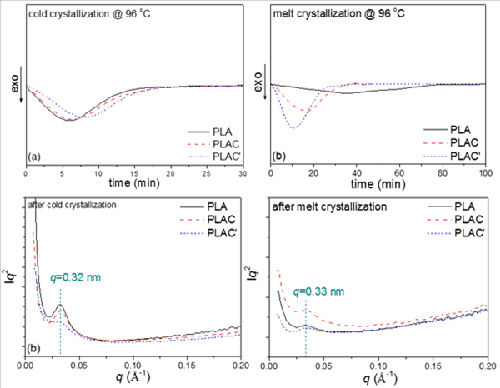
Polylactide (PLA) composites with pristine cellulose nanocrystals (CNC) and acetylated one (aCNC) were prepared for the crystallization study. The roles of CNC andaCNC in cold and melt crystallization of PLA were explored. Both CNC andaCNC have good nucleation activity during cold crystallization of PLA, but also highly impede transport of adjacent chain segments to the growing surface, acting as the role of physical barrier in the glassy bulk. Within the experimental temperature range, growth dominates the overall kinetics, rather than nucleation. Therefore, barrier role overwhelms nucleation agent one and as a result, the cold crystallization rates of composites decrease as compared with neat PLA, accompanied by decreased degrees of crystallinity. During melt crystallization, although the presence of CNC andaCNC leads to sharply increased system viscosities, reducing chain mobility, nucleation is the dominant role as the systems crystallize from the melts. Thus, the presence of CNC andaCNC promotes melt crystallization of PLA, and the composites show far higher crystallization rates and degrees of crystallinity than neat PLA. Besides, the surface acetylation of CNC improves its nucleation ability during melt crystallization of PLA, and as a result, the composite withaCNC has denser fold surfaces relative to the one with CNC. But the presence of these two kinds of particles has no evident influence on the lamellar structure of PLA whether in the cold or in melt crystallization. This work can provide useful information on the crystallization control of PLA using CNC.
PDF DOWNLOAD:
http://www.polymer.cn/ss/wudefeng/publicationsshow_10021.html

 苏公网安备 32100302010246号