A novel photoluminescent Cd(II)-organic framework exhibiting rapid and efficient multi-responsive fluorescence sensing for trace amounts of Fe3+ ions and some NACs, especially for 4-nitroaniline and 2-methyl-4-nitroaniline
Ying-Jiao Yang, Meng-Jie Wang, Kou-Lin Zhang*
School of Chemistry and Chemical Engineering,YangzhouUniversity,Yangzhou225002, P.R. China
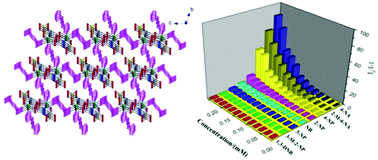
The first photoluminescentCd(II)-organic framework{[Cd(5-asba)(bimb)]}n(1)based on amulti-functional ligand 2-amino-5-sulfobenzoic acid(H25-asba) has been successfully constructed.The structure of1was determined by single crystal X-ray diffraction analysis, revealing that1exhibits a six-connectedα-poloniumnetwork with Schläfli symbol 41263. The phase purity of the bulk sample of1was further confirmed by elemental analysis and powder X-ray diffraction pattern (PXRD) which is consistent with the simulated one calculated from single crystal X-ray diffraction data.Optical property of1was characterized bythe solid stateUV-visdiffusereflectance spectrum, indicating that1may be a potential candidate for wide gap semiconductor material.Photoluminescent properties of1well dispersed in various solvents have been investigated in detail, indicating that1showsdistinct solvent-dependent photoluminescence.1belongs to the rare category of MOFs that exhibits the multi-responsivephotoluminescence sensing properties.Itcan be used as a rapid and efficient selective fluorescence sensor forFe3+ionsin environment and biological system at about one ppm level.For photoluminescence responses of1dispersed in aqueous solution with incrementally increased4-nitroaniline (4-NA) and 2-methyl-4-nitroaniline (2-M-4-NA)concentrations, photoluminescence quenching was detectable even at a very lowconcentration of 0.52 ppm for4-NA and 0.68 ppm for 2-M-4-NA, respectively, indicating1exhibits extremely high sensitivities for 4-NA and 2-M-4-NA.Further systematic study reveals that1shows more efficient sensing ofnitroaniline homologues(4-NAand2-M-4-NA)over other electron-deficient nitroaromatic compounds (NACs).1represents the first case of a MOF-based photoluminescent probe for4-NAand2-M-4-NA. Furthermore,1can discriminate the nitrophenol isomers (2-, 3- and 4-NP)through fluorescence sensing.To our best knowledge,1is the firstCd(II)MOF based on the multi-functional ligandH25-asba that can be used as amulti-responsive efficient sensory material for Fe3+ions and some NACs, especially for nitroaniline homologues (4-NAand2-M-4-NA).
文章链接:
http://pubs.rsc.org/en/results?artrefjournalname=j.%20mater.%20chem.%20c&artrefstartpage=11404&artrefvolumeyear=2016&fcategory=journal
J. Mater. Chem. C, 2016,4, 11404-11418
张扣林论文1

 苏公网安备 32100302010246号