Design and preparation of polymer resin-supported organoselenium catalyst with industrial potential.
Yuguang Wang, Lihua Yu, Bingchun Zhu* and Lei Yu,*
aKey Laboratory of Bioorganic Synthesis of Zhejiang Province, College of Biotechnology and Bioengineering, Zhejiang University of Technology, Hangzhou, China
E-mail: zhumelta@163.com
bZhejiang Research Institute of Chemical Industry, Hangzhou, China
cJiangsu Co-Innovation Centre for Prevention and Control of Important Animal Infectious Diseases and Zoonoses, Jiangsu Key Laboratory of Zoonosis, School of Chemistry and Chemical Engineering, Yangzhou University, Yangzhou, China
E-mail: yulei@yzu.edu.cn
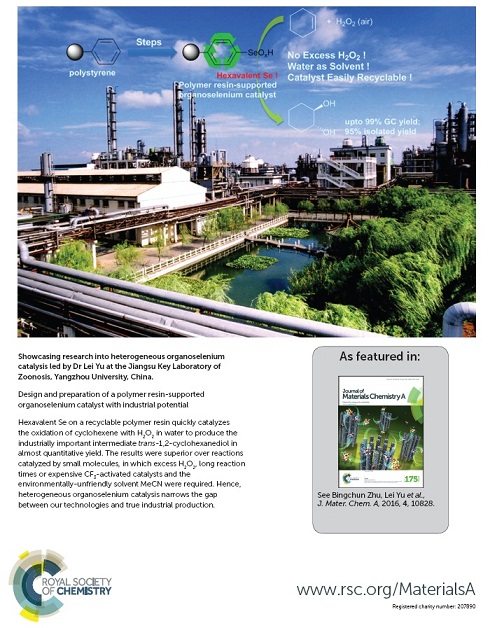
Abstract:Hexavalent Se? Yes! Selenium on polymers exhibits quite different properties compared to that in small molecules. Hexavalent Se, rare in organoselenium chemistry, was found to be the major species on polymers. The high-valent Se species on recyclable polymer resins could quickly catalyze the oxidation reaction of cyclohexene with H2O2 in water to produce industrially important intermediate trans-1,2-cyclohexanediol in almost quantitative yield. In the catalytic cycle, high valent Se species were reduced to divalent Se, a highly activated species that could be re-oxidized by air so that no excess H2O2 was required for the reaction. The results were superior to those of reactions catalyzed by small molecules, for which excess H2O2, long reaction time or expensive CF3-activated catalysts and environmentally unfriendly MeCN solvent were required.
J. Mater. Chem. A, 2016,4, 10828-10833
文章链接: http://pubs.rsc.org/en/content/articlelanding/2016/ta/c6ta02566h#!divAbstract
文章附件:

 苏公网安备 32100302010246号