Nanostructured palladium catalyst poisoning depressed by cobalt phosphide in the electro-oxidation of formic acid for fuel cells
Ligang Feng, Jinfa Chang, Kun Jiang, Huaiguo Xue, Changpeng Liu, Wen-Bin Cai, Wei Xing, Jiujun Zhang
a School of Chemistry and Chemical Engineering, Yangzhou University, Yangzhou 225002, China
b State Key Laboratory of Electroanalytical Chemistry, Laboratory of Advanced Power Sources, Changchun Institute of Applied chemistry, Chinese Academy
of Sciences, Changchun 130022, China
c Shanghai Key Laboratory of Molecular Catalysis and Innovative Materials, Collaborative Innovation Center of Chemistry for Energy Materials,
Department of Chemistry, Fudan University, Shanghai 200433, China
d Institute for Sustainable Energy, Shanghai University, Shanghai 200444, China
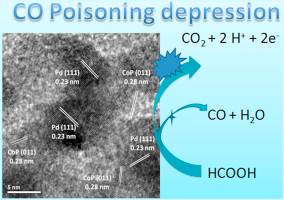
Abstract:Nanostructured palladium is considered as the best catalyst materials for direct formic acid fuel cells but catalyst poisoning suffering from the intermediates seriously reduces catalytic activity and stability, thus further hinders the commercial application of fuel cells technology. Herein, we report the tricky Pd catalyst poisoning problem could be greatly depressed by cobalt phosphide (CoP) material during formic acid oxidation, so an extremely active and stable Pd catalyst with very low Pd loading (5 wt%) is realized. The high anti-poisoning ability was evidenced by a significantly faster kinetics study and less poisoning intermediates adsorbed on its surface compared with Pd/C catalyst. When integrated into a real fuel cells model, a power density of 150 mW cm−2 catalyzed by this Pd-CoP/C catalyst (5 wt%, Pd) was comparable to that of the commercial Pd/C catalyst (20 wt%, Pd) indicating a very promising application in the electrochemical energy devices. This work opens an avenue to overcome the universal catalyst poisoning issue and pushes Pd catalyst system much stronger for commercial application in fuel cells technology.
Nano Energy 2016, 30, 355–361
文章链接
1-s2.0-S2211285516304414-main

 苏公网安备 32100302010246号