Nitrogen-enriched meso-macroporous carbon fiber network as a binder-free flexible electrode for supercapacitors
Lei Fan, Li Yang, Xiangying Ni, Jie Han*, Rong Guo**,Chuanfang (John) Zhang
aSchool of Chemistry and Chemical Engineering, Yangzhou University, Yangzhou, 225002, China
bKey Laboratory of Advanced Energy Materials Chemistry (Ministry of Education), Nankai University, Tianjin, 300071, China
cCentre for Research on Adaptive Nanostructures and Nanodevices (CRANN), Advanced Materials and BioEngineering Research (AMBER), School of Chemistry, Trinity College Dublin, Dublin 2, Ireland
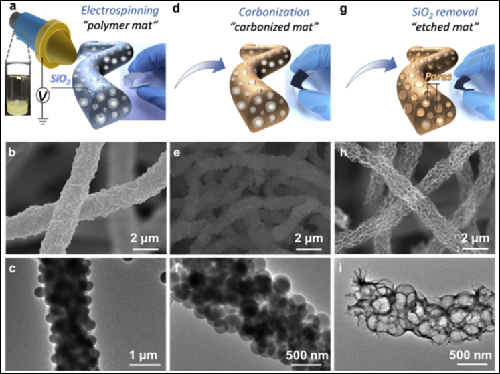
Abstract:In order to maximize supercapacitor performances, it is essential to engineer the electrode architecture with shortened ion-diffusion paths and high content of pseudocapacitive sites. By incorporating redoxactive species into low-dimensional carbon materials, both the specific capacitances and rate capabilities can be improved. In this study, a self-sustaining,flexible mat consisting of nitrogen-enriched carbonfiber (NCF) network was successfully produced through the co-electrospinning of a polyacrylonitrile (PAN)/polyvinylpyrrolidone (PVP)/SiO2blended solution, followed by pyrolysis and SiO2removal processes. Despite its low surface area (<60 m2/g), the NCF exhibits high nitrogen content (17.3 wt%) and interconnected meso-macroporous nanostructure, resulting in high pseudocapacitance (242 F/g at 0.2 A/g), fast rate capability, and excellent cycling performance (99% of initial capacitance after 5000 cycles). The electrical double-layer capacitance and pseudocapacitance can be easily decoupled. The binder-free NCF based symmetric supercapacitor demonstrates a purely capacitive responses and high rate handling. We attribute the excellent electrochemical performances to the good conductivity and shortened ion diffusion paths of carbonfiber backbone, and pseudocapacitive edge-concentrated nitrogen species.
Carbon, 2016, 107, 629-637.
文章链接:
Carbon 1-s2.0-S000862231630522X-main

 苏公网安备 32100302010246号